 Lakes Guides, topics
 |
 |
|
||
| iron yetts, Cumbria | ||||
| county:- | Cumbria | |||
| Fireproof Doors |
||||
| In a pele tower it is no use vaulting the basement and taking other precautions against
attack, if the enemy could gain access by burning dor the door:- |
||||
| "Thei layed corne and straw to the doore, And burnt it both rofe and flore And so smoked theym out." |
||||
| So the doors were of wrought iron, cross barred. |
||||
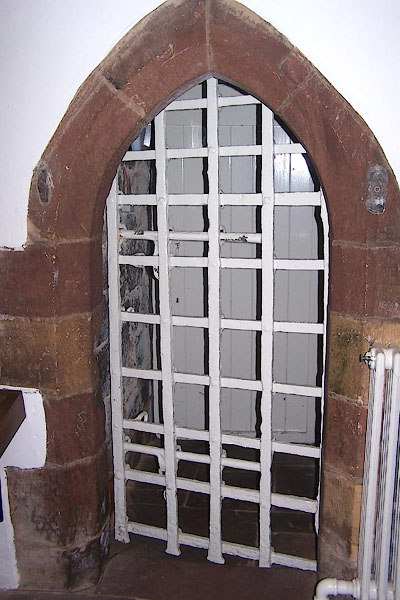 BMA86.jpg |
||||
| When James I of Scotland became James VI of England he appointed a commission for
the pacification of the borders, and ordered:- |
||||
| "... the haill of the Irione yettis in the houssis on the Bordouris to be removit and
turnit in plew ironis or other necessar work" |
||||
| In Scotland the vertical and horizontal bars penetrate one another making a solidly
wrought barrier; the doors in England have the horizontals laid atop the verticals,
which makes it easy to board one side with horizontal planks between the bars, the
other side vertically. The doors were hung so that they could not easily be lifted
off their pintles. Iron bolts ran into holes in the stonework, fixed by a hasp over
a staple fastened with a padlock. |
||||
|
|
||||
| CBE93.jpg |  |
St Cuthbert, Great Salkeld, NY55173675 -- Door to the tower. (photo 21.7.2014) | ||
| BMA86.jpg |  |
St Michael, Burgh by Sands, NY32865911 -- Door, an iron yett, to the church tower. (photo 5.5.2006) | ||
| BZY63.jpg |  |
St Michael, Burgh by Sands, NY32865911 -- Door, an iron yett, to the church tower. (photo 28.2.2014) | ||
| BZY64.jpg |  |
St Michael, Burgh by Sands, NY32865911 -- Bolt on the iron yett. (photo 28.2.2014) | ||
|
|
||||
| references:- |
Curwen, John F: 1913: Castles and Fortified Towers of Cumberland, Westmorland, and
Lancashire North of the Sands: Wilson, Titus (Kendal, Westmorland) |
|||
|
|
||||
 Lakes Guides menu.